

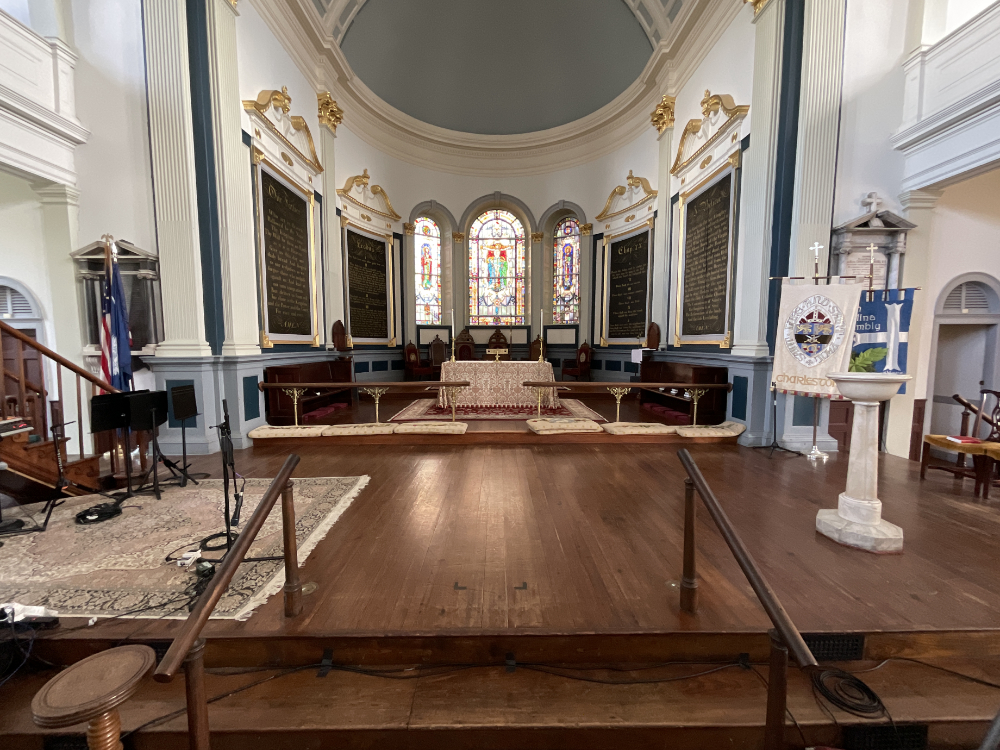
The Stage and the Altar
The signs and symbols we humans use to communicate to ourselves and each other are never neutral, each carries an obvious, direct connection to the idea of the object that it represents, but more subtle are the relationships these signs can have to other ideas, attitudes, or priorities that we may or may not intend to communicate.
St. Augustine spent many pages exploring the proper use and classification of creation and how to apply these ideas apply to the preaching of the Gospel. The semantics of the language we use to communicate our faith is oftentimes difficult to parse and must be approached with a concerted application of both our will and our reason. As this pertains to the use of verbal language that we have been schooled in from birth, how much more care must be taken with those non-verbal signs and symbols that we use in the expression of our faith.
Given this, I do not think it is amiss to explore these non-verbal avenues of expression and the subtle but substantial impact they can have on how we convey the gospel message and worship our Creator and Lord.
To start, let me give a summary of the relevant points that have bearing on this topic. As limited humans, we have no choice but to communicate with signs and symbols. They are at the same time both crucial and fragile. There is no such thing as a neutral symbol only ones that are assumed to be neutral because they are the cultural default, the norm. Change or remove the symbols and what they mean and you change the culture. This is true in all areas of our lives, but it is especially true when we are communicating with each other about God. It is impossible for us to clearly communicate about the totality of God because we only know about Him what He has chosen to reveal to us. Words alone are rarely adequate to this task.
In art, there is a hierarchy of communication when expressing emotions. When words become inadequate we start to sing and when singing fails to express the depth of feeling we begin to dance because there is a connection between our body’s movement and our emotions that gets to places that our words alone cannot. Movement requires space and so how a space is arraigned and manipulated and moved through is a form of communication that can be more powerful than words. When the words we use and the motions we make don’t match it creates confusion and uncertainty even though the friction may be hidden from our immediate awareness.
This has obvious application to the work done during a church service. Inside the walls of our church there is a core drama, a tension, that is being played out in nearly every service. And that is the impossible, nearly irreconcilable tension between the eminence and the transcendence of God. The baffling contradiction of the high and holy folding Himself down into human lowliness. This is the core of St. Paul's creed, believeing that Jesus Christ is Lord. In this elemental creed, we are not asked to merely affirm that there is a God, or that we have generally favorable views of Him. We are called in this creed to affirm that this one particular person, this human Jesus, is also God. Time and inculturation has dulled the shear absurdity of this creed. For us, the deity of Jesus is accepted as a given only because we have been reared to take it as true. Because of this, we humans are prone to forget the powerful revelation of this dichotomy. It is in constant danger of sliding toward the mundane. But, in realty, this divine incarnation is an idea that goes so far beyond what our spoken words can communicate or what we can even sing, it must also be communicated also through our bodily actions.
In the context of the Anglican service, this tension between the eminence and transcendence of God runs like a thrumming chord stretched tight between the altar and the pew, between God and His people. It is between these two points that this drama unfolds. We do not participate in this drama for God’s benefit but for our own, to remind us every time of what we can so easily forget, the majestic strangeness, the nearly unapproachableness of a High and Holy God. It is only when this realty is remembered that the full weight of gratitude can be felt. A gratitude that we, through the bodily work of Christ Jesus, have the privilege and the right to approach the High and Holy as children asking for bread, knowing with full assurance that we will receive it. The incomprehensible significance of Christ’s work to bridge the gap between God and man only has meaning to us when we are reminded of how great that gap is.
There are various signs and symbols, actions, and movements that we use throughout the Anglican service to communicate this central truth. This is the culture of the altar. But there is another culture that, over time, seems to be supplanting the altar’s dramatic, impossible story, and that is the culture of the stage. Here the tension is cut, the cord between the altar and the pew slackened. But we love the stage because that is where the humans stand and perform. In most churches, the pulpit is set up as the primary center of attention where someone will stand and speak their words or sing their songs. And as lovely, and true and encouraging as these words are they are no substitute for the far more powerful symbols that stand behind that pulpit at the altar.
There is a cumulative effect to the stage that gathers more and more of the service onto itself while obscuring more and more the altar. This is because the stage is an unexamined default based on our wider collective culture. The stage is familiar to us, it is powerful in our minds because it is from the stage that we are entertained and inspired. It is where we go to watch and listen and absorb, be it in the classroom, the theater, the concert hall, or the movies.
The stage divides the space it occupies differently than the altar. Every stage comes with an invisible wall that separates the performance and performers from the audience, the active from the passive, the product from the consumer. It is all deeply comfortable to us, familiar and mundane. It is a context in which we know our role as an audience members and that is to do as little as possible so that I do not disturb the performance. The stage, by its very presence, comes with cultural taboos that explicitly forbid our participation.
In these contexts, the altar is in competition with the stage for our attention. They are, each one, a sign and each communicates disparate things about who we are as a church and why we are there. And we would be forgiven for thinking that it all seems to be a muddled mess because the culture of the stage is being implemented without being thoroughly examined as a cultural default, and the culture of the altar is being abandoned without its value being thoroughly understood.
This is not to say that the stage is inherently bad, there are hundreds of thousands of churches around the world that use the culture of the stage, it is now in this country, the default norm. The altar has been losing ground to the pulpit since the days of the Puritans who would “run to hear good preaching” and despised the Papish ways of the Church of England. But the question that we must answer is are we sure that what we are taking up is more valuable than what we are letting go of and are we even aware that we are doing it?
But often those churches that still hold to the signs and symbols of the altar are pressured to downplay or eliminate these symbols in favor of stage culture by those church members who come from that culture and are more comfortable with it.
But do they understand what they are changing? Are churches being reactive to complaints when we could be proactive in education?
I have experienced this shift in my church.
When the stage grows in ascendancy there is no longer a thrill in the air as we watch the cross make its way among us, very few follow it on its journey to and from the altar, most everyone is looking at the stage, at the performance, the cross seems superfluous in these moments.
In the culture of the stage, we may no longer kneel during the service or pray the Prayer of Humble Access. Words and actions that explicitly state the relationship between God and His people, that point to and make clear the wonderful absurdity that is about to take place, the vast gulf that we are about to traverse with grateful hearts and open hands. Do we know why we have given that up and was it worth the cost?
Is this not to say that every service in every Anglican church must be a fully sung, rite one service but we must wonder if we are fully aware of and okay with giving up the important statements that are communicated in those services? Do we understand what we abandoned, and if we don’t, how can we know we are not letting go of important, powerful ways of communication and replacing them with less effective or even counterproductive methods?
The complaints about the priest preaching from the high lectern or wearing fancy garments only make sense when coming from the culture of the stage, which is probably the culture that most visitors and newcomers are coming from. If the service is seen as a performance then it’s all just costume and theatrics and you will get reviews of your performance because that is the only participation the stage culture allows the audience. (This is not to say that altar culture does away with critics, they are after all, inescapable.)
But in the culture of the altar, we are all there as participants together. We are not an audience, but a communion, there to remind ourselves and each other of the tension between ourselves and our God. In this context, the vestments are part of that reminder to help our too forgetful minds. It is not worn for performance but as a response. As are all of the other parts of the liturgy, the standing, kneeling, bowing, processing, etc.
The beauty of the altar culture is that it allows space for personal expression and reverence and provides a space of permission for these personal acts. Some will cross themselves, others will bow when entering the aisle, or any of the other private expressions that can fit among the larger framework of our collective worship. In stage culture, these expressions become absurd and disruptive. In altar culture, we all bear the responsibility of the life of the church both in the service and outside of it. Church is not a place I go to to consume but a community I belong and contribute to.
So, in conclusion, this is not a request to go back to a previous worship style, but a request that as we go forward that we ask hard questions about why we come to church. Because, as much as I dearly love all of you who are on the stage, you are not what draws me back week after week. There is something bigger, someone greater that brings me back and we all have the privilege of worshiping Him together